The original Nature letter.
Reprinted by permission from Nature July 11, 1953, Vol.
172, p.82,
copyright 1953 Macmillan Publishers Ltd.
A 'Rex' Mutant in the Cat
In the house-mouse, five genes are
known with much the same action on the fur: shortening the
guard-hairs, curling the whiskers, and making the baby
coat (sometimes the adult too) wavy1. Three
recessive genes in the rabbit, rex-1, rex-2, and rex-3,
affect guard-hairs and whiskers as in the mouse mutants;
the fur is not wavy, however, but is short and plush-like.
There are also similar mutants in the rat2.
A similar 'rex' type of
mutant has now turned up in the cat (see accompanying
photograph). The fur of affected kittens is wavy; later it
becomes very woolly to the touch, just like a young rex
rabbit. The adult hair is curly but has the velvet texture
of the rex rabbit; the whiskers are curled.
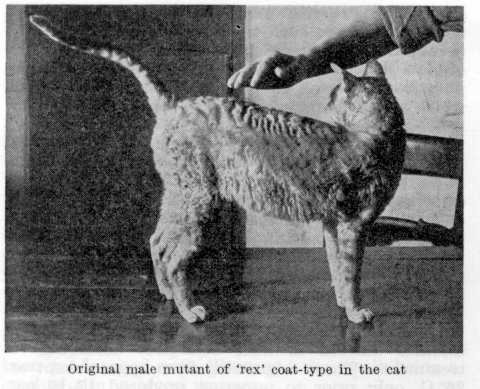
The original mutant (a male which also carries the
sex-linked gene for yellow hair colour) has been mated to
his tortoise-shell mother. Seven kittens have been
produced so far, of which three have been rex. So the
condition is inherited; but it is not yet possible to tell
whether as a recessive or a dominant.
It is hoped to publish further
details later3.
A. C. Jude
3 Hill View Road, Mapperley,
Notts. May 23.
1 Grünebarg, H., "The Genetics of the
Mouse" (Martinus Nijhoff, 1952).
2 Grüneberg, H., "Animal Genetics
and Medicine" (Hamish Hamilton, 1947).
3 Searle, A.G. and Jude, A.C.,
"........" (Journal of Genetics, 1956).
(The source code for this web reproduction is copyright, Tony Batchelor, 2002)
|